
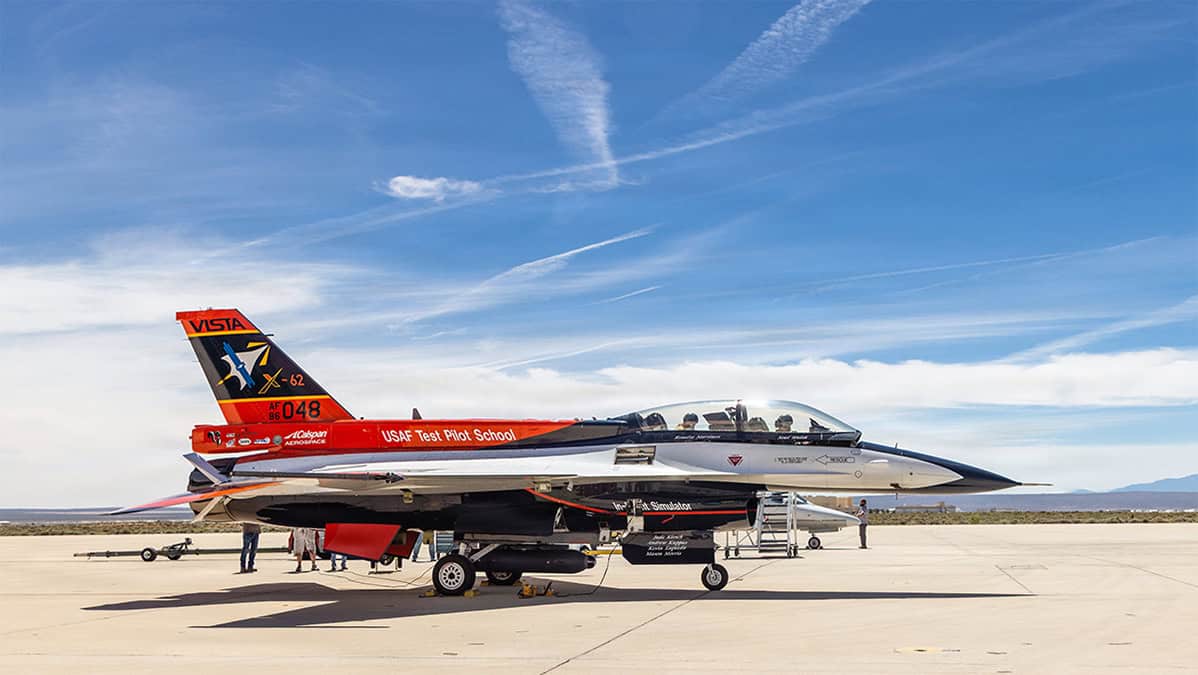
EDWARDS AIR FORCE BASE — In August 2026, more than 80 individuals from industry, academia and the joint force converged on the historic Air Force Test Pilot School campus at Edwards Air Force Base for the inaugural X-62 Research Symposium. The three-day summit quickly set the foundation for future research in autonomy-enabled combat aviation through the nation’s first AI X-plane.
The summit included briefings from the Department of the Air Force, the Defense Advanced Research Projects Agency, the Air Force Research Laboratory, MIT Lincoln Laboratory and the Air Force Institute of Technology, among others. Operational aircrew from an Air Combat Command fighter squadron also shared recent real-world operational perspectives on bridging the gap between pilot trust and machine learning.
With a sprint goal of establishing three future flight test concepts that could be executed on the X-62 from fiscal 2027 to 2028, stakeholders collaborated on a final proposal of more than 30 concepts, a reflection of the substantial, previously untapped demand for the X-62 across the joint enterprise.
“The X-62 Summit was the first time we convened stakeholders across the spectrum of capability development of autonomy tools for combat aviation,” said Col. Maryann Karlen, commandant of the Air Force Test Pilot School. “We were awed by the level of positive responses and interest. This demonstrates, without a doubt, the demand for testbeds like the X-62.”
The intentional collaboration ensures a shared roadmap for X-62 testing upon conclusion of its ongoing Mission Systems Upgrade. Enabled from investment by the Test Resource Management Center, the Mission Systems Upgrade program incorporates advanced radar, increased computing power and expanded sensor capacity that allows the X-62 to both complement existing combat autonomy systems, such as VENOM, while rapidly pathfinding emerging uses across the Department of War’s highest priority programs.
The upgrade program is executed through the Air Force Test Center, in collaboration with Lockheed Martin Skunk Works, Calspan Corporation, the Air Force Research Laboratory and RTX. Multiple attendees of the inaugural X-62 Summit pose for a photo on the iconic Rodgers Dry Lake, making the shape of a V to represent the iconic VISTA name on Aug. 11 at Edwards Air Force Base. (U.S. Air Force photo by Brandon Hernandez)
Preparation for the X-62 ‘busy season’
To prepare for the forthcoming high workload in the X-62’s test schedule, the Air Force Test Pilot School and mission partners embarked on a staff-led series of test missions designed to develop and codify the logistics and integration framework required to execute at high rates. Dubbed “HAVE HOLIDAYS,” the unique tests were performed in parallel to the “HAVE HEAT” AI interception milestones, successfully demonstrating the X-62’s framework can transition from laboratory to flight at the speed of now.
The HOLIDAYS included:
• HAVE BALLDROP: Derived from the Air Force Research Laboratory’s “xFACTOR” program, this marked the integration of a non-prime, third-party autonomous agent onto the X-62, paving the way for seamless partnerships across government, industry and academia. This test also provided critical validation for AFRL in integrating systems with a low technology level into other systems with a high degree of advanced mission autonomy.
• HAVE THANKS: In collaboration with the Air Force Research Laboratory’s information and spectrum warfare directorate, the X-62 flew with BirdBox, an open-architecture software framework designed for next generation Assisted Target Recognition sensor data exploitation at the tactical edge.
• HAVE DREIDEL: In collaboration with 3Laws Robotics, this commercial runtime assurance software evaluated the feasibility of the X-62 flying with guardrails designed to prevent autonomous vehicles from violating user-established operational limits. This integration provides the option to deploy the runtime assurance capability for additional active safety protection.
• HAVE SANTA: In collaboration with IBM and Lockheed Martin, this integration investigated the feasibility of an on-platform parallel simulation using IBM’s NorthPole neuromorphic chip, a lower-power neural inference processor for edge SI. The chip was placed within the VISTA computers to assess its environmental performance under flight conditions. Simultaneously, the chip successfully accelerated Lockheed Martin Skunk Works’ custom “Supermassive” simulation, executing parallel trajectory simulations in flight.
As the X-62 enters the next phase of its historic career, the end goal of educating and informing future test leaders remains the same. While the nation’s first AI X-plane is of service to many, Air Force Test Pilot School students will remain the primary innovators as AI-enabled combat aviation bridges the gap for air superiority and beyond.
CHASE KOHLER is part of the public affairs staff of the 412th Test Wing at Edwards Air Force Base. This story featured contributions by Noel Zamot.
Source: Edwards AFB news release dated Oct. 13, 2026