
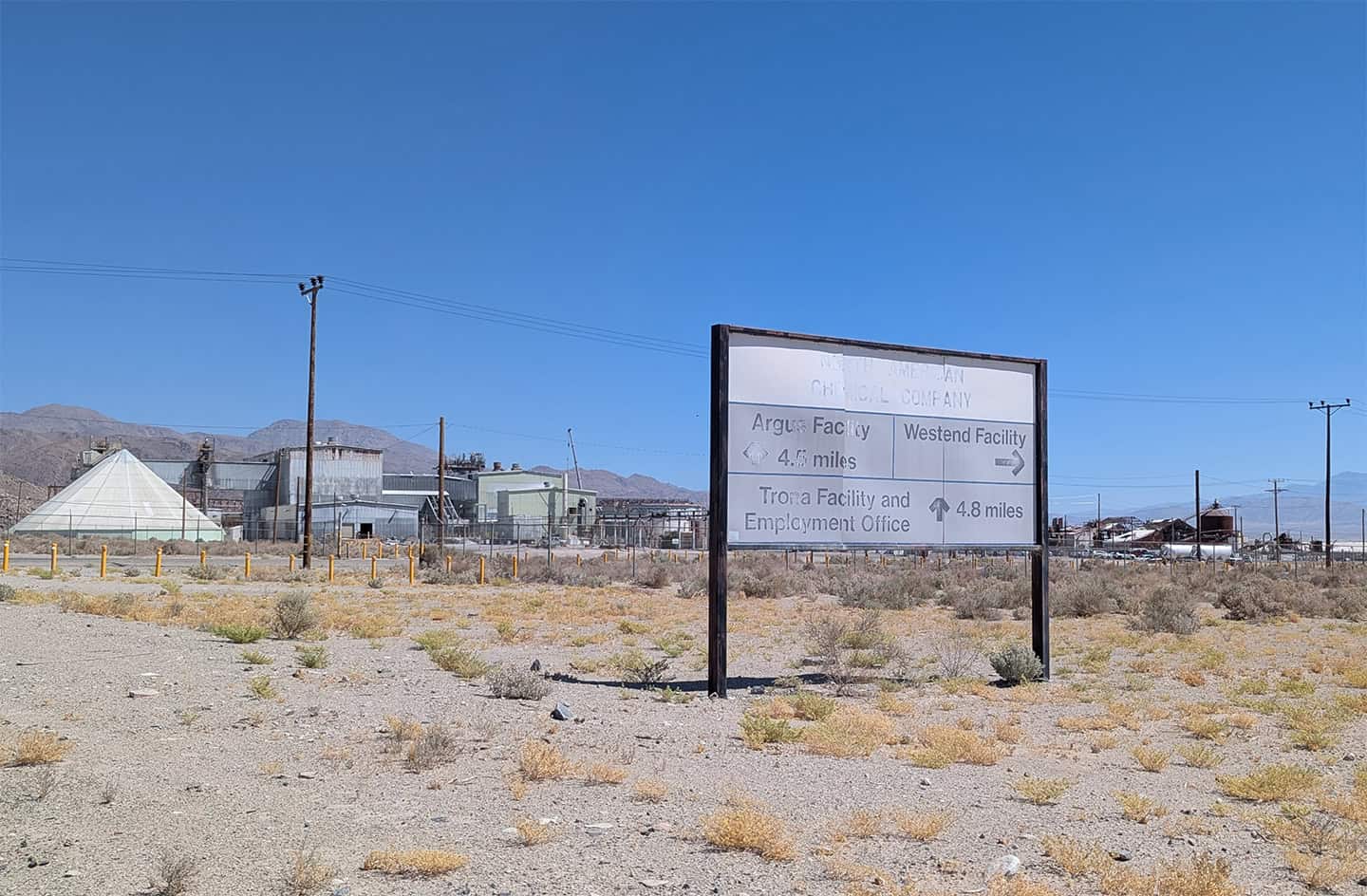
Similar versions of this article were published in The Daily Independent, Ridgecrest (July 28, 2026), The Bakersfield Californian (July 23, 2026), and Tehachapi News (July 24, 2026).
TRONA — The tiny town of Trona had something to celebrate in January — a brand-new $80 million high school, largely funded by California’s Office of Emergency Services.
Less than a month later, the news was grim. Trona’s major employer, Searles Valley Minerals, announced layoffs of about half its workforce. About four months later — on June 15 — Searles filed a Chapter 11 bankruptcy proceeding that includes a planned sale of the company.
While Searles continues to operate, the bankruptcy process is keeping a federal court in Wilmington, Del., busy. More than 200 filings are filling the case docket as creditors and other parties — including Searles’ parent company — wrangle for position.
Earthquake recovery funding paid for Trona Joint Unified School District’s new high school. The old high school was seriously damaged in back-to-back earthquakes on July 4 and 5, 2019.
Called the “Ridgecrest earthquakes,” the seismic events caused more than $5 billion in damage, much of it at the Naval Air Weapons Station China Lake, northwest of Trona.
Physical damage at Searles Valley Minerals— and throughout the region — was immediately apparent, but it took a while for the true loss to be known.
According to filings made with the bankruptcy court, the company sustained about $50 million in repair costs and a dramatic drop in revenue following the earthquakes.
Seven years later, the company said in its filing, the damage to Searles’ extraction operation hasn’t been fully restored and production remained at about half of pre-earthquake levels.
Although the unincorporated community of Trona, founded as a company town in 1913, is in San Bernardino County, many employees live in Ridgecrest. The company is headquartered in Overland Park, Kan.
Searles operates as a wholly owned subsidiary of Karnavati Holdings, Inc., which is owned by Nirma Limited, a major Indian industrial conglomerate. Nirma purchased Searles from a private investment firm, Sun Capital Partners, and other minority shareholders in a deal announced by The Times of India in November 2007. The newspaper said the all-cash acquisition was expected to cost Nirma $200 million.
Profitable before earthquakes
Mining in the dry lakebed at Trona dates to the late 1800s.
Searles was consistently profitable before the earthquakes, its filing shows — reporting operating profit of $56 million in fiscal year 2017, $46 million in fiscal year 2018 and $52 million in fiscal year 2019.
In addition to earthquake impacts, the company cited oversupply by lower cost producers of synthetic soda ash from China as a trigger for the bankruptcy filing.
In a news release in June, Searles said it intends to use the Chapter 11 process “to conduct a competitive, court-supervised sale of substantially all its assets under Section 363 of the Bankruptcy Code.”
The company filed concurrent petitions for relief for two affiliates, Trona Railway Company and Searles Domestic Water Company.
It stated in the news release that all operations will continue throughout the Chapter 11 process with Tata Chemicals North America Inc., agreeing to provide an unsecured, interest-free liquidity advance of up to $20 million and Karnavati Holdings, Inc., “providing a $20 million junior debtor-in-possession financing facility.”
Who are the creditors?
Searles bankruptcy filings identify creditors including owners Nirma and Karnavati, along with Tata and HSBC, the bank that loaned the company funds secured by assets before the bankruptcy filing.
As of Wednesday, 79 claims have been filed, four of them against Trona Railway Company rather than Searles Valley Minerals directly. Several hundred additional creditors — of Searles, the railway, and Searles Domestic Water Company — are listed in the companies’ own schedules rather than through individually filed claims.
Two federal agencies have filed claims and schedules filed by the company listed governmental entities including Kern, San Bernardino and Inyo counties and various state agencies.
The California Air Resources Board tops all claim amounts; Searles lists the agency on one of its schedules for a debt of more than $76.3 million.
The Internal Revenue Service has filed claims totaling more than $2.2 million.
The federal Office of Natural Resources Revenue, which collects royalties on mineral leases like Searles’ BLM sodium operation, has filed a claim for $435,111.
Local companies filing claims so far include Shawn Barker Construction, Core and Main, LP, both of Trona.
Among the largest unsecured creditors, with a claim of $311,250, is Continental Labor & Staffing Resources, a Bakersfield company with an office in Ridgecrest. The company’s founder and CEO is Shannon Grove, who represents the 12th state Senate District.
Five other claims have been filed from Bakersfield firms including Surface Pumps, Inc., Western Oilfields Supply Co. dba Rain for Rent, Sunrise Mechanical, Valley Valve and MP Environmental Services.
Dirk Bentz of Bakersfield Machine Company is among members of the creditors’ committee. Searles listed his company on a schedule with a $748,427 debt.
Creditor concerns
The official committee of unsecured creditors on July 14 filed an objection to some of Searles’ plans for continued operation and sale of the company. A meeting of creditors was set for July 23.
Bankruptcy documents for the Searles Valley Minerals filing identify the company as the “debtor in possession” or DIP and the “DIP lender” as Karnavati Holdings with Nirma providing the funding to allow continued operations.
In its filing the committee noted it understood that the debtors need money to continue to operate and pursue a sale through the Chapter 11 process.
“However, absent a sale that is the equivalent of a ninth inning grand slam, unsecured creditors’ most likely source of recovery is through litigation,” the filing noted, adding that its investigation suggested litigation “could yield meaningful recoveries for creditors,” a possibility the committee said would be lost if the proposed DIP financing were approved on the terms Searles proposed.
According to the creditors committee, that plan would include requiring Searles to deliver 3,300 metric tons of product to Nirma or Nirma’s designee, without receiving any new money. Other concerns included the fees the creditors committee is being allowed and a general concern that there is “a grave risk of administrative insolvency” with inadequate funding for the bankruptcy case.
The creditors committee also questioned what it called Nirma’s actions prior to the bankruptcy filing to “‘ring fence’ its profitable assets from its risky assets, and to shield itself from liability related to Searles.
On July 17, the debtors (Searles, et al) replied to the committee’s filing, stating that agreements made to provide cash to operate through the bankruptcy were “on favorable terms” and the only option available after an investment banker canvassed the market.
Due primarily to “misunderstandings or misconstruction” of certain provisions of the proposed financing, “the committee impugns the debtors’ process and implies that the parent’s financial support of the debtors is part of a sinister plot designed to protect the parent. This is an unfounded and unfortunate misconception.”
Noting that the Searles companies are central to the town of Trona, providing jobs for 250 people, potable water and electricity to the airport and could not operate through the sale process without support, the filing stated that “simply put, the protections that the parent is receiving in exchange for providing such support are well within the bounds of reasonableness and were approved by a highly involved independent director appointed nearly three weeks before the petition date with a clear mandate.”
Since the July 17 filing, issues between Searles and the committee — and concerns raised by another creditor, Sisecam Wyoming LLC, a mining and refining company in Wyoming that is listed on a schedule as a general unsecured creditor owed more than $1.6 million — were resolved, so a planned hearing was canceled. A court order shows that the committee’s professional fee budget was increased from $1.6 million to $2.5 million and it was provided with a $300,000 investigation budget.
Education impact
Trona has a new high school thanks to OES funding, but the school district’s financial situation is far from bright.
Declining enrollment is also a challenge for the school district. According to the California Department of Education, 242 students across all grades were enrolled during the school year that ended in June. This was down from 336 in 2019.
Lower enrollment means less revenue based on average daily attendance, and at TJUSD, the financial problem is compounded by a drastic drop in funding related to the mining operation.
Searles operates on land it owns and property leased from the federal government. For more than 100 years, federal law has required mining companies to pay royalties to extract certain minerals, including soda ash.
For the operation in Trona, a portion of those royalties are passed on to the state of California, which identifies the revenue as “potash” and distributes it to Trona Joint Unified School District and the Kern Community College District. Although Trona is in San Bernardino County, it is within the boundaries of the college district. In recent years, KCCD has allocated its potash revenue to Cerro Coso Community College, headquartered in Ridgecrest.
Advocacy led by then-Rep. Kevin McCarthy of Bakersfield, then-Rep. Paul Cook (now a member of the San Bernardino County Board of Supervisors), and others, resulted in streamlined authority for the BLM to adjust mineral royalty rates, according to a September 2020 BLM press release and related statements from McCarthy and Cook’s congressional offices.
In an October 2019 press release from the U.S. Department of the Interior, Cook noted that Trona had been significantly damaged by earthquakes, and said the rule proposed at the time “sets the stage for rapid relief that will protect and expand mining jobs, strengthen our national security, and help local soda ash producers in my district recover from a devastating natural disaster.”
Cook represented California’s 8th Congressional District, which includes Trona.
Using that authority, the BLM reduced the federal royalty on soda ash from roughly 6% to 2% for a 10-year period effective Jan. 1, 2021. This, combined with Searles moving away from soda ash production, has dealt a serious blow to school and college financing.
Reports from the state controller’s office show an approximate 60% decline in potash revenue for the school district and college district from FY 2017-18 to the current fiscal year. In April, the total apportionment fell to $2,982, down from $159,824 the previous month, apparently due to Searles mothballing its Argus plant and discontinuing soda ash production to preserve liquidity.
The state apportions approximately 85% of its potash revenue to the school district and 15% to the college district.
In June Trona’s school board approved a resolution that noted the district has been in deficit spending for at least 10 years and committed about $6.2 million of potash revenue to cover four years of projected operating deficits.
What’s next?
Searles’ stated goal in the Chapter 11 proceeding is to find a buyer for the entire Trona operation — Searles Valley Minerals and its affiliates — Trona Railway Company and Searles Domestic Water Company.
What isn’t clear is what will happen with the company’s CARB liability, unpaid BLM royalties and income and property taxes — or how water litigation might impact a future buyer.
The company late last year announced a settlement with the Indian Wells Valley Groundwater Authority that resulted in $24 million in debt forgiveness for Searles in exchange for agreements to prioritize using reclaimed water, dismiss its own lawsuits against IWVGA and work to implement IWVGA’s groundwater sustainability plan.
Still an issue is how much water Searles will be allowed to pump in the future. Searles’ water rights are part of a court case pending in Orange County Superior Court to adjudicate Indian Wells Valley groundwater rights.
Notices of sale published recently in The Daily Independent, Ridgecrest, and The New York Times outline important dates for the proposed sale of the Searles companies. Aug. 6, 11:59 p.m., is the bid deadline. Aug. 13, 10 a.m. is the time set for the auction. Aug. 17 is the deadline for the successful bidder to file a purchase agreement and Aug. 19, 4 p.m., is the deadline to object to the sale. Aug. 26, 1:30 p.m., is the sale hearing. All times are Eastern.
More information
More information about the bankruptcy filings is available online at cases.stretto.com/SVM.
CLAUDIA ELLIOTT is the founder and editor of The Mojave Beat.