Similar versions of this article were published in The Daily Independent, Ridgecrest (Aug. 20, 2026), and The Bakersfield Californian (Aug. 21, 2026).
TRONA — Searles Valley Minerals, Inc., filed for Chapter 11 bankruptcy protection on June 15. The company’s plan — a “free and clear” sale of its assets — was complicated earlier this month with filings from the California Air Resources Board asking the court to ensure that a $76.3 million environmental obligation survives the sale.
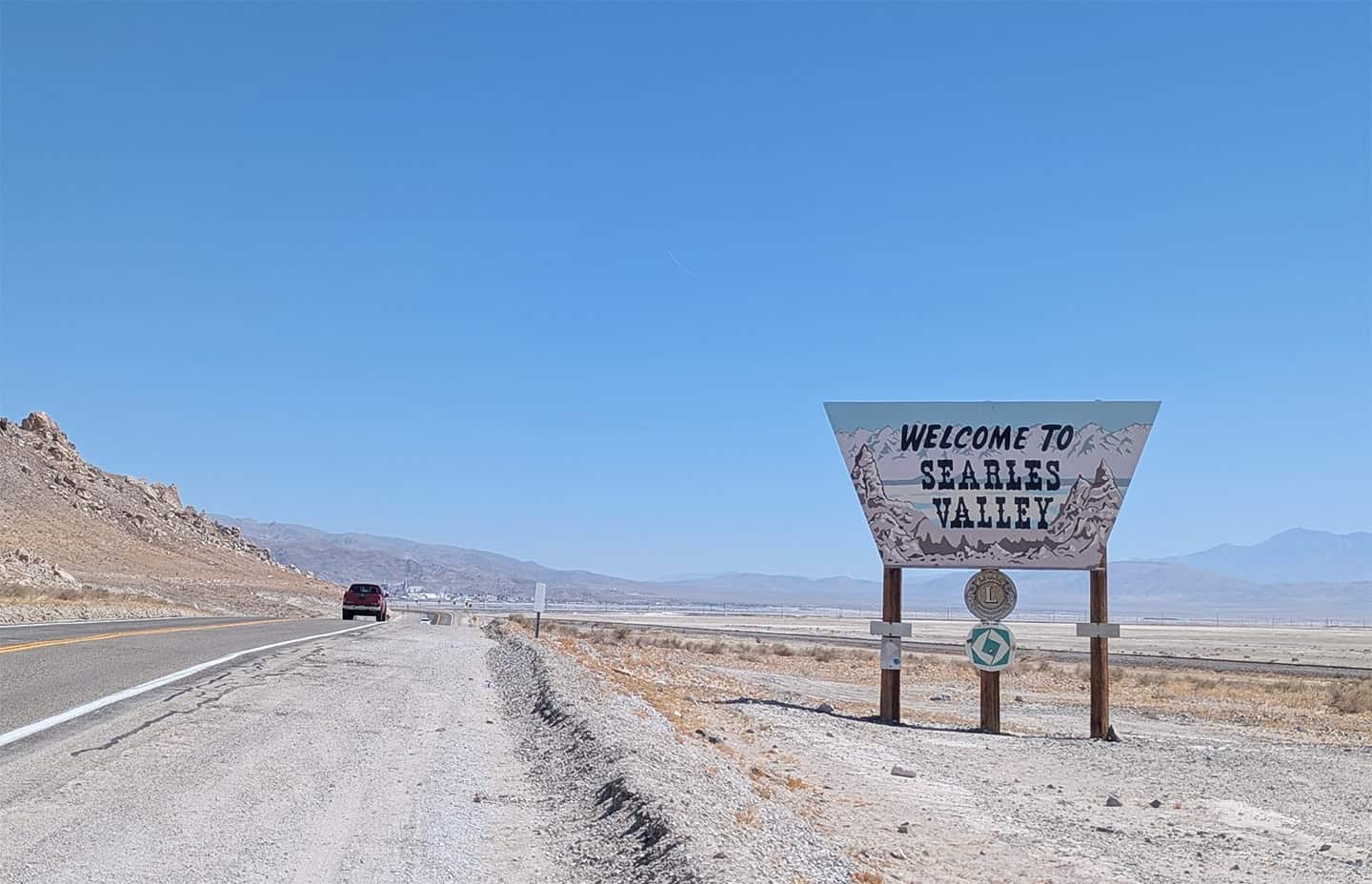
Searles and two associated companies operate in Trona, an unincorporated San Bernardino County town about 25 miles northeast of Ridgecrest. Many of its employees live in the Ridgecrest area.
Earlier this year the company mothballed part of its operation and permanently laid off about 46% of its prior workforce — 240 employees and independent contractors.
Since the bankruptcy filing, the docket of the federal bankruptcy court in Delaware has filled with nearly 300 filings. Liabilities total more than $431 million, including claims from creditors, the parent company and claims from associated companies. In addition to SVM, the bankruptcy action includes Searles Domestic Water Company, LLC, and Trona Railway Company, LLC. Karnavati Holdings, Inc., SVM’s parent company, has a claim of more than $135 million and Trona Railway has a claim of more than $83 million. The state of California’s $76.3 million CARB claim is the next highest claim so far.
In its filing objecting to sale of company assets, CARB said “the sale of assets, as proposed, may unlawfully interfere with or preempt the total greenhouse gas emissions subject to the CARB’s Cap-and-Invest Program.” Citing a 1993 case, CARB stated “Responsibility for pollution imposed under environmental laws is not a claim that can be discharged, even if the duty imposed will cost the future owner money to comply with law.”
A hearing on the state’s motion is set for Aug. 26, after the Aug. 17 deadline for potential buyers to submit bids. As of Thursday morning, CARB’s filings had not been answered.
A state senator’s view
Responding to an inquiry about CARB’s court filings, state Sen. Rosilicie Ochoa Bogh, R-Redlands, said news of Searles’ bankruptcy filing was devastating and she criticized CARB’s stance.
“Learning that Searles Valley Minerals filed for bankruptcy was devastating, as hardworking families in Trona and surrounding communities depend on these jobs,” Ochoa Bogh said. “For years, the Trona plant has faced mounting challenges from rising energy prices, increasing regulatory burdens, and higher compliance costs under California’s Cap-and-Invest program. These conditions, coupled with California’s insistence that CARB regulations remain in place, make it increasingly difficult for any new owner to keep the plant open.
“California cannot claim to support domestic manufacturing and critical mineral production while implementing policies that drive up energy costs, raise taxes, and add regulatory barriers, making it nearly impossible for companies to compete globally,” Ochoa Bogh continued. “To ensure economic growth, safeguard jobs, and help businesses thrive in our communities, California must foster a more pro-business environment.”
CARB’s claim is tied to SVM’s obligation under what is now called California’s “Cap-and-Invest” program, formerly known as “cap-and-trade.” For nearly 20 years the state agency has been tasked with helping meet the state’s climate goals by capping how much pollution is allowed and incentivizing power plants, factories and fuel suppliers to reduce greenhouse gas emissions. According to CARB’s filings, the company’s unmet obligation under the program has resulted in the $76.3 million debt, and the state wants the court to ensure the obligation survives the sale and transfers to whatever company buys the operation.
Coal use at Trona
The Searles operation at Trona may be the last coal-fired power generation in California and CARB’s concern is tied to those emissions. In Trona, Searles and predecessor companies have used coal-fired power generation since at least 1977. When the company produced soda ash — prior to changes announced along with the layoffs earlier this year — coal-fired generators produced steam heat used to process the brine pumped from Searles Lake into soda ash.
In response to an inquiry, on Thursday, a spokesperson for Searles said “the Argus facility has been mothballed as part of SVM’s response to current economic and market conditions affecting soda ash production. While production at Argus has been paused, SVM’s utilities operations remain operational and continue to provide the essential services needed to support the company’s remaining operations, infrastructure, and environmental and safety systems.”
The coal-fired boilers at Searles are located at the Argus facility, and in a May 2026 comment to CARB, Searles President Dennis Cruise suggested that coal is still used and that the change in production is likely to produce greater emissions. Searles has asked CARB to consider the energy required to produce borates from brine, which is a different process from open-pit mining of borates used at Boron, in assessing the company’s environmental obligation.
CARB gives companies free “credits” (allowances) based on a formula— a benchmark— for how much pollution their type of production is supposed to produce. That benchmark was based on emissions from a normal borate operation. But in comments to CARB in May, Cruise said the actual pollution, per ton of borate, is now higher than that benchmark assumes because waste heat from soda ash production is no longer available, so the free credits it gets won’t cover what Searles actually needs for borate mining.
SVM operates as a wholly owned subsidiary of Karnavati Holdings, Inc., which is owned by Nirma Limited, a major Indian industrial conglomerate. Nirma purchased Searles from a private investment firm, Sun Capital Partners, and other minority shareholders around November 2007. Searles was consistently profitable before the earthquakes, its filing shows — reporting operating profit of $56 million in fiscal year 2017, $46 million in fiscal year 2018 and $52 million in fiscal year 2019.
Mining in the dry lakebed at Trona dates to the late 1800s. In addition to earthquake impacts, the company cited oversupply by lower cost producers of synthetic soda ash from China as a trigger for the bankruptcy filing. Searles has reported it is currently mining borates and that it mothballed its soda ash and boric acid facilities at Trona and nearby Argus. A plan to convert one of two generators to solar, announced as a partnership by the firm GlassPoint in 2025, is not mentioned in the bankruptcy filing and apparently was not completed. GlassPoint’s media team did not respond to a request for comment.What’s next?
Searles’ stated goal in the Chapter 11 proceeding is to find a buyer for the entire Trona operation — Searles Valley Minerals and its affiliates — Trona Railway Company and Searles Domestic Water Company.
The company’s CARB liability is just one of many issues the court may consider before finalizing the sale or bankruptcy.
Dates to wrap up the sale have changed. The bid deadline was Aug. 17 and the auction date is Aug. 24, according to a revised schedule released Thursday morning. A hearing on the sale, in addition to the hearing on CARB’s motion, is now set for Aug. 26 with a possible continuation to Aug. 27.
More information about the bankruptcy filings is available online at cases.stretto.com/SVM.
CLAUDIA ELLIOTT is the founder and editor of The Mojave Beat.