
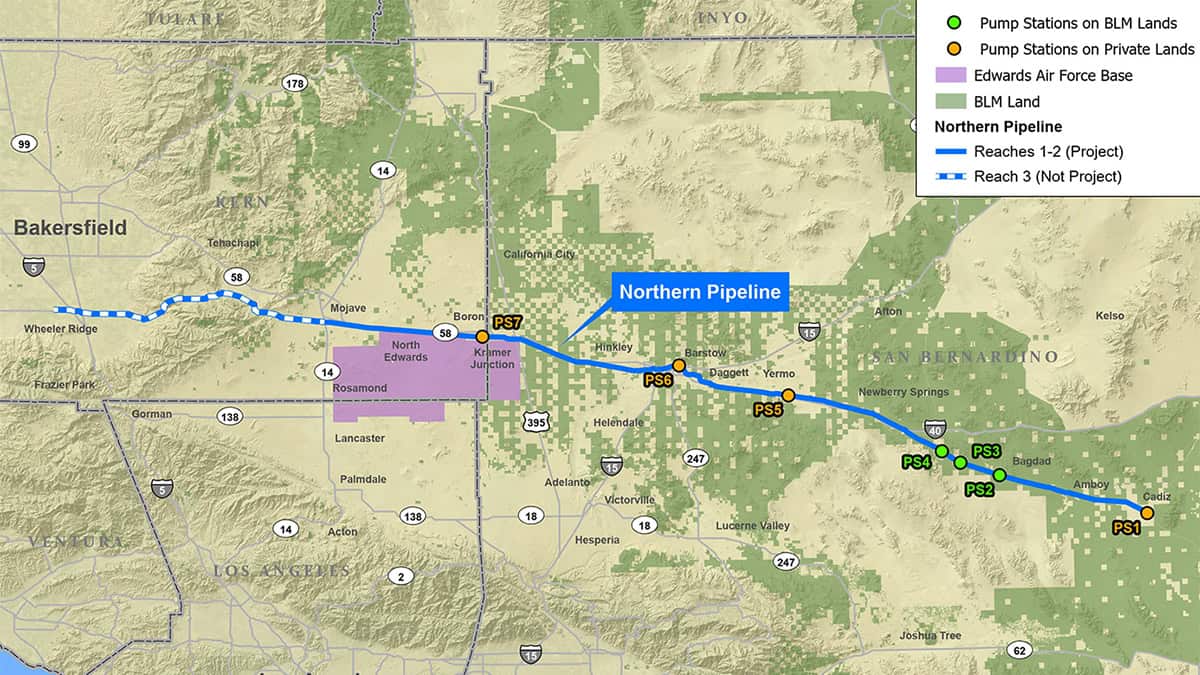
CADIZ — In August, the company that proposes delivering water from a remote community in the eastern Mojave Desert to Kern County, reported executing construction contracts guaranteeing a maximum project cost of about $403.3 million and late last month it said the project “has earned broad support across the region — from both business and labor, as well as farmers, housing advocates, water agencies and the families they serve.”
The project has garnered some support in Kern County.
The Kern County Board of Supervisors, the city of Tehachapi, the Boron Community Services District, and the Desert Lake Community Services District have expressed varying levels of support for the project in letters to the California State Lands Commission.
Status
The right-of-way for the project — known as the Cadiz Northern Pipeline — was approved by the Bureau of Land Management in July, but the project still needs additional approvals. The project is sometimes called the Mojave Groundwater Bank.
The BLM’s approval was challenged in court in late July by the Center for Biological Diversity and the Sierra Club, and the litigation is ongoing.
Environmental groups, including the Center for Biological Diversity and the Sierra Club, claim that pumping groundwater at Cadiz will dry up springs that desert wildlife depend upon. Two tribal groups have filed a separate suit with similar claims, emphasizing natural springs, wildlife and cultural resources.
Part of the proposed pipeline to carry water runs through about a mile of state-owned school lands located southeast of the city of Barstow. In March, Fenner Gap Mutual Water Company, managed by Cadiz, Inc., filed a lease application for the land, which remains pending.
Kern support
A comment letter from the Kern County Board of Supervisors to the commission was approved on Oct. 13, according to board minutes, with four supervisors voting in favor and Leticia Perez absent.
The board’s letter states that its support for the Cadiz Northern Pipeline project is “contingent on the successful completion of these required processes and on clear findings that the project’s operations will protect California’s desert ecosystems, cultural resources, and groundwater basins.”
The letter noted that “the county recognizes the significant potential of the proposed project to enhance water supply reliability, expand groundwater storage capacity, and support regional resilience in the face of drought and ongoing Colorado River shortages. Cadiz Inc.’s proposal to repurpose an existing, long-idle natural gas pipeline into a conveyance system capable of moving groundwater north toward Kern County represents a notable effort to utilize existing infrastructure for public benefit.”
The letter acknowledged litigation from environmental organizations and several tribal governments over the federal approval.
The city of Tehachapi, in a letter to the commission signed by Assistant City Manager Corey Costelloe, expressed support for the Cadiz Northern Pipeline Project and encouraged the state commission “to recognize the importance of projects that add practical water management tools for California.”
Costelloe noted that “while not immediately necessary for our community, we believe the Northern Pipeline can provide important regional benefits by expanding the state’s ability to store, convey and exchange water supplies during both dry and wet years when storage is important.”
A city spokesperson said that the undated letter was sent on Sept. 30.
Tehachapi-Cummings County Water District
On Oct. 21, an agenda item for a meeting of the Board of Directors of Tehachapi-Cummings County Water District asked the board to direct the general manager to send a letter of support for the Cadiz project.
In a staff report, General Manager Tom Neisler said proponents of the Mojave Groundwater Bank were “seeking support from a coalition to demonstrate widespread support for the project.”
Neisler told the water district board he didn’t see a downside to sending a letter supporting the project, but the agenda item failed to attract a motion.
During the meeting, he told the board that David Villarino, former executive director of FIELD (Farmworkers Institute of Education & Leadership Development), which the district has contracted with in the past, was soliciting support for the project.
Efforts to contact Villarino to confirm his involvement with the project were unsuccessful.
Board President Robert Schultz noted that he would abstain from voting on the matter if it went to a vote. He added that a portion of the pipeline runs through his ranch and that it also runs right outside the gate of the water district headquarters property on Banducci Road.
‘Reach 3’ not included
The pipeline also runs through Boron, near both the Boron and Desert Lake community services districts. In September, both sent letters in support of the project to the State Lands Commission.
The current Cadiz Northern Pipeline project proposal does not include “Reach 3,” from Mojave to Wheeler Ridge, according to the BLM’s July 2026 environmental assessment.
According to that document, “Reach 3 would remain authorized under the current MLA ROW and is not part of this Proposed Action.”
Neither the BLM nor Cadiz, Inc. responded to questions about what would be required to convert “Reach 3” of the pipeline — from Mojave through the Tehachapi area and on to Wheeler Ridge — to carry water.
About the pipeline
Cadiz was first developed as a railroad town. Located just south of the Marble Mountains near the National Trails Highway, Cadiz was developed as a water stop and named in 1883 by Lewis Kingman, a locating engineer for the Atlantic and Pacific Railroad.
In recent years, the name has become better known for a controversial water project envisioned by Cadiz, Inc., a Los Angeles-based company. The publicly traded company owns around 45,000 acres of land at Cadiz and plans to sell water from the underlying aquifer.
The company was founded in 1983 and began farming in the early 1990s, according to its website (cadizinc.com). In 1998, it said, it began an environmental review and sought authorization to use the desert aquifer as a groundwater storage bank.
Proposed projects have changed through the years, with the latest effort focused on what the company calls the Mojave Groundwater Bank, and specifically the Northern Pipeline Project.
The 30-inch steel pipeline was originally developed in the mid-1980s to carry heavy crude oil from processing facilities in Santa Barbara County, through Kern County, then across the desert and eventually to West Texas. Kern County property records show right-of-way deeds to All American Pipeline Co. were recorded between 1985 and 1987. In some cases, as Schultz noted at the water district board meeting, All American used eminent domain to force right-of-way acquisitions. County records also show some property owners agreed to sell their right-of-way without court action.
In 2000, El Paso Natural Gas acquired at least part of the pipeline and proposed converting it to carry natural gas.
According to reporting in The Bakersfield Californian in September 2002, “The pipeline in question travels just more than 303 miles from Ehrenberg, Ariz., across the Colorado River through Riverside County and San Bernardino County to Daggett, Calif., and into Kern County, ending in Bakersfield.”
At a public meeting sponsored by the U.S. Bureau of Land Management and the State Lands Commission, it was reported that state documents showed that a “residential subdivision near Stallion Springs, west of Tehachapi, has been built over the 30-inch pipeline since it was built in the 1980s.”
That conversion was approved, but State Lands Commission records show that approvals in 2005 only covered the pipeline from Ehrenberg to Cadiz. The Tehachapi-area segment west of Cadiz was left idle. The commission cited public safety in Stallion Springs as one reason for not approving the longer reach.
Beginning in 2011 and continuing until 2020, Cadiz acquired the pipeline stretching from Cadiz to Bakersfield.
More information is online.
Claudia Elliott is the founder and editor of The Mojave Beat. She can be reached at claudia@mojavebeat.news.