
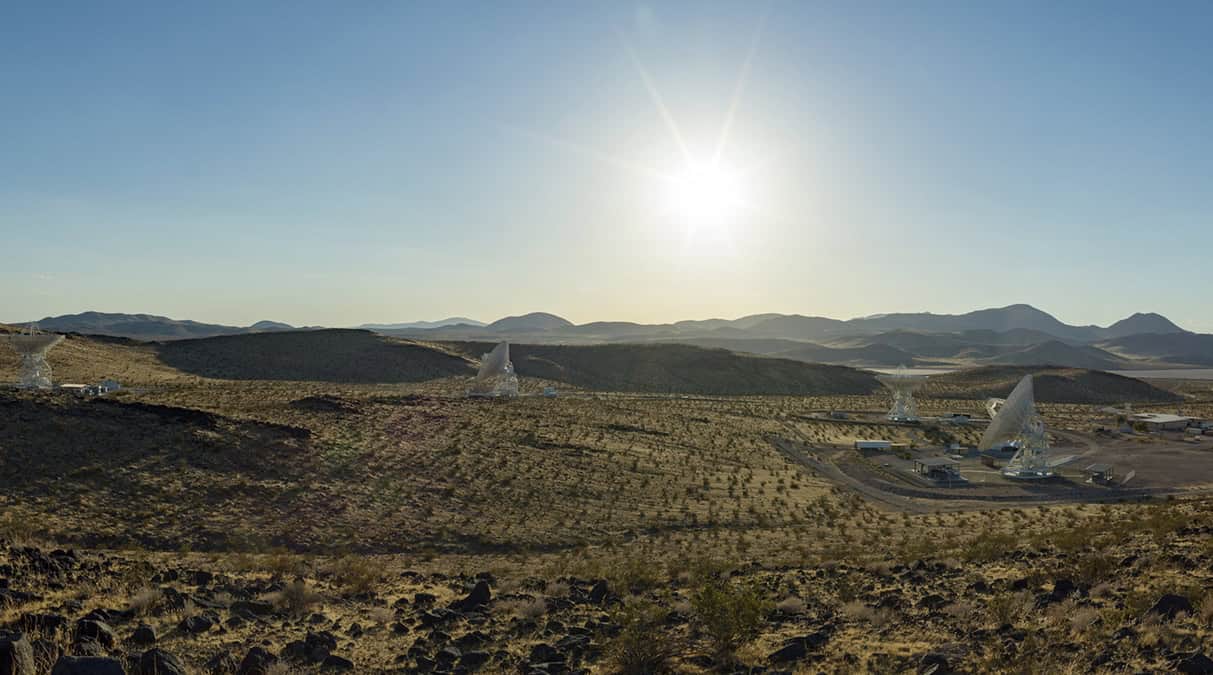
MOJAVE DESERT — NASA’s Deep Space Network recently added a new 34-meter (114-foot) radio antenna at its Goldstone Deep Space Communications Complex near Barstow, according to a news release from the Jet Propulsion Laboratory (JPL).
Goldstone sits on a remote stretch of land inside the U.S. Army’s Fort Irwin military base in the Mojave Desert. JPL manages the network for NASA.
The antenna, Deep Space Station 23 (DSS-23), was recently marked with a ceremonial ribbon cutting attended by NASA leaders, JPL personnel and dignitaries, the release states.

Leadership from NASA Headquarters, the Jet Propulsion Laboratory, and the Deep Space Network pose in front of the recently completed Deep Space Station 23 (DSS-23) antenna at the Deep Space Network’s Goldstone complex near Barstow. — NASA/JPL-Caltech
After testing from May through July, DSS-23 began operations Aug. 3 by tracking NASA’s Chandra X-ray Observatory, the release says. It has since communicated with dozens of missions, including the Mars Reconnaissance Orbiter, Psyche, Juno and Voyager 1.
JPL said construction began in February 2020. The 133-ton reflector framework was installed atop the pedestal in December 2024, followed by the reflector panels and a calibration process so the antenna can work with the rest of the network.
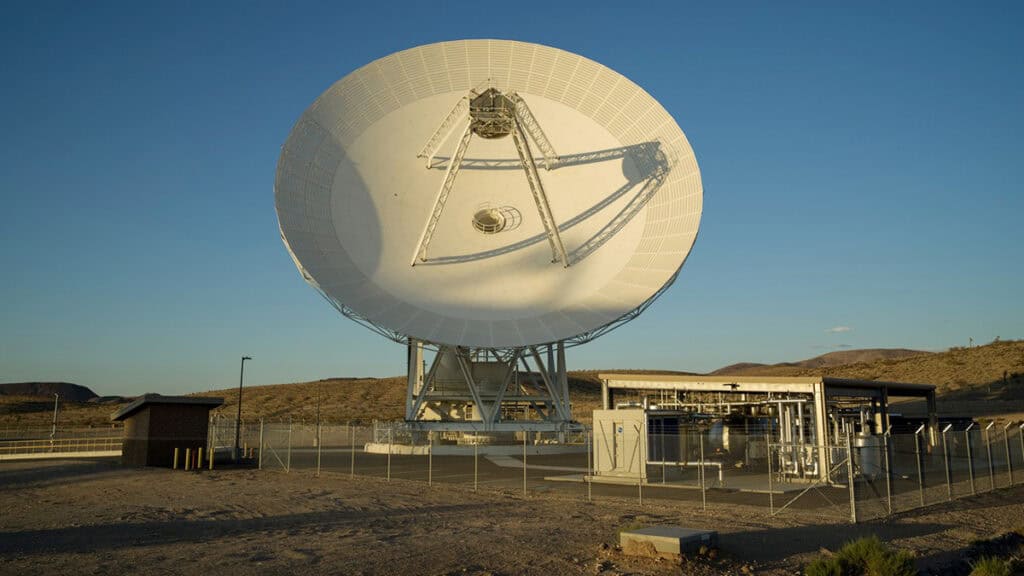
Long shadows are cast by the recently completed Deep Space Station 23 at the Deep Space Network’s Goldstone complex near Barstow. A multifrequency beam waveguide antenna, DSS-23 will boost the DSN’s capacity and enhance NASA’s deep space capability. — NASA/JPL-Caltech
DSS-23 is the fifth antenna at Goldstone, joining three other 34-meter dishes and one 70-meter (230-foot) dish. It is also the fifth antenna completed under the network’s Aperture Enhancement Project, which began in 2009 to add six new 34-meter beam-waveguide antennas, according to JPL. The design routes signals to a climate-controlled underground room instead of housing sensitive electronics on the moving dish, which JPL says makes maintenance and upgrades easier.
The project will conclude when Deep Space Station 33 comes online at the network’s Canberra, Australia, complex in 2029, bringing the network’s total to 13 34-meter antennas, the release says. The 34-meter dishes can be arrayed to serve as a backup for each complex’s 70-meter antenna, which JPL says is increasingly costly to maintain after more than 50 years of near-continuous operation.
“The addition of this next-generation antenna brings us closer to a completely modernized network,” JPL Director Dave Gallagher said in the release.
The Deep Space Network, which also has complexes near Madrid and Canberra, supports more than 40 spacecraft, according to JPL.
Source: JPL news release dated Aug. 25. 2026