
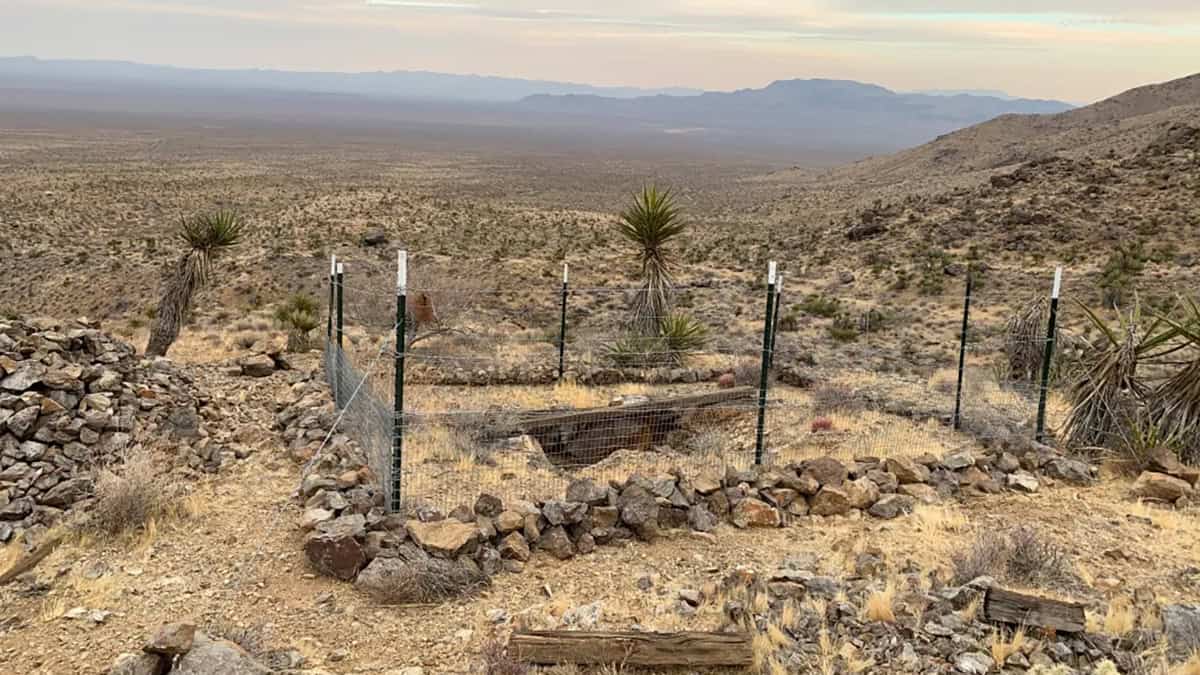
MOJAVE NATIONAL PRESERVE — Mojave National Preserve draws hundreds of thousands of visitors a year, including hikers, hunters, campers and rockhounds. Scattered across it are the remains of California’s mining past, and some of those remains can kill.
Earlier this year, staff from the California Department of Conservation’s Division of Mine Reclamation (DMR) completed one of the department’s largest single remediation projects to date. Its aim was to make those sites safer without erasing the history or the wildlife that now depends on them.
A five-year project
According to the department’s Public Affairs office, the Mojave project covered 65 abandoned mine features over five years. Discussions with the National Park Service began in 2020. In 2021, staff secured $675,000 in federal grant funding to pay for most of the work. The department then hired Frontier Environmental Solutions, a remedial contractor that followed state procedures and protocols.
After the contractor finished, DMR staff visited all 65 mines to inspect the work. According to the department, 70% of the sites had no previous safeguarding.
Between 2021 and 2025, crews worked in difficult conditions. They drove rough roads in four-wheel-drive vehicles, camped, hiked cross-country and worked underground inside abandoned mine features. Staff traveled in pairs with spare tires, satellite phones and GPS tracking, and did most of the work between September and April to avoid summer heat.
“It was a multi-year project, from remediation scoping … to the environmental compliance MOJA does, to getting a contractor onboard for the construction, and over a year of construction work to build the project fully,” said project lead and Senior Environmental Scientist David Tibor. “Our small group has driven and hiked all over the Mojave National Preserve.”
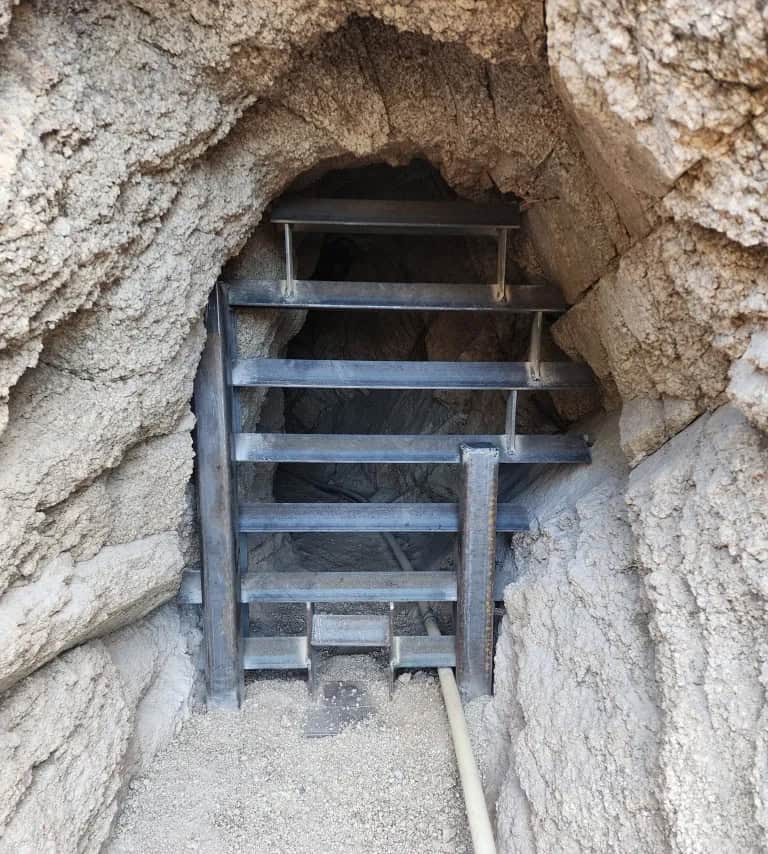
An example of a bat gate, featuring a tortoise “door.” — Courtesy of California Department of Conservation, Abandoned Mine Lands Unit
Keeping people out, letting wildlife in
The department says it did not simply seal the mines. Many are habitat, especially in desert areas where mines shelter wildlife from extreme heat and cold. Crews installed fences, wire nets and, most notably, bat gates. The barred gates have openings of about 5-3/4 inches, which let bats fly through while keeping people out. At many of the Mojave sites, crews also installed an 8-by-10-inch door at ground level for the Mojave Desert tortoise, a threatened species.
Bats and tortoises are not the only residents. Mines in the preserve are home to ringtails, barn owls and smaller birds, including a nest of baby Say’s phoebes the department photographed. Snakes, including rattlesnakes, are common.
Most of the 65 sites are near drivable open routes, the department says, so the work is meant to protect passersby as well as wildlife. The team is continuing similar work with the National Park Service and other partners elsewhere in California, from Death Valley National Park to Whiskeytown National Recreation Area.
About the unit behind the work
DMR’s Abandoned Mine Lands Unit (AMLU) was created in 1997. Its team of geologists, scientists and GIS professionals conduct inventories of mines and their use by wildlife, then helps public agencies design, contract and install fixes. Funding comes from state fees collected on gold and silver mined in California, federal funds and other special funds. Projects are often built by small businesses under contract.
The scale of the problem is large. The department says California has tens of thousands of abandoned mines, many dating to the Gold Rush, in all 58 counties. About 64% are on federal land, 32% on private land and 4% on state or local land.
What explorers need to know
The department’s safety guidance is blunt: Stay Out – Stay Alive. The hazards are not always visible.
Shafts can be hidden. Vertical shafts can be hundreds of feet deep and may be unprotected, covered by vegetation or capped with rotting boards.
Sturdy-looking openings can fail. Rotting timbers and unstable rock can cause cave-ins even where an opening looks solid.
Underground is disorienting. Darkness and debris can leave visitors lost, and winzes, drifts and stopes present falling hazards.
Explosives may remain. Unstable dynamite or blasting caps can detonate at any time.
The air can be deadly. Pockets of oxygen-depleted air or lethal gas, such as carbon monoxide, can cause asphyxiation.
Wildlife lives inside. Rattlesnakes, mountain lions and bears may use old mines for shelter.
Dust and water carry risks. Dust at mine sites may cause illnesses such as hantavirus or valley fever, or health problems from naturally occurring elements like asbestos, arsenic or chromium. Mine sites can also contribute toxic waste and heavy metals to watersheds.
The department’s records, compiled from news stories and agency records, document deaths and near misses in California’s abandoned mines. Victims’ reported ages range from 2 to 75. Those records show 13 fatalities in 2010–2019 and none in 2020–2025, but they also show 11 injuries or near misses in 2020–2025, plus pets and other animals.
The department cautions that the real numbers are likely higher than documented, because people may choose not to report incidents.
The preserve itself appears in the record. In November 2020, two park visitors nearly drove their Jeep into an abandoned shaft in Mojave National Preserve. No one was hurt.
Incidents often involve more than one person, and some deaths occurred during attempted rescues. In October 2023 in Kern County, for example, one person fell 120 feet down a shaft and two friends who tried to help could not climb out. Firefighters rescued all three, and the person who fell had life-threatening injuries.
If something goes wrong
In an emergency, call 911 or your local sheriff’s office. If someone is hurt or trapped, do not attempt a rescue yourself. Rescues should be made only by trained professionals with proper equipment, to avoid further injury to the victim or the rescuer.
To report an abandoned mine, call the DMR toll-free hotline at 1-877-OLD-MINE (1-877-653-6463) or email DMR@conservation.ca.gov. Include the location (GPS latitude and longitude, nearest road name or Assessor’s Parcel Number) and a description of the mine site or feature.
Sources: California Department of Conservation, “The Mojave Mine Project: How We Help Preserve a Preserve” (DOC Public Affairs, June 29, 2026); Division of Mine Reclamation, “Abandoned Mines in California” and Abandoned Mine Lands Unit materials; DMR, “Safety at Old Mines: Stay Out – Stay Alive!” (October 2026).