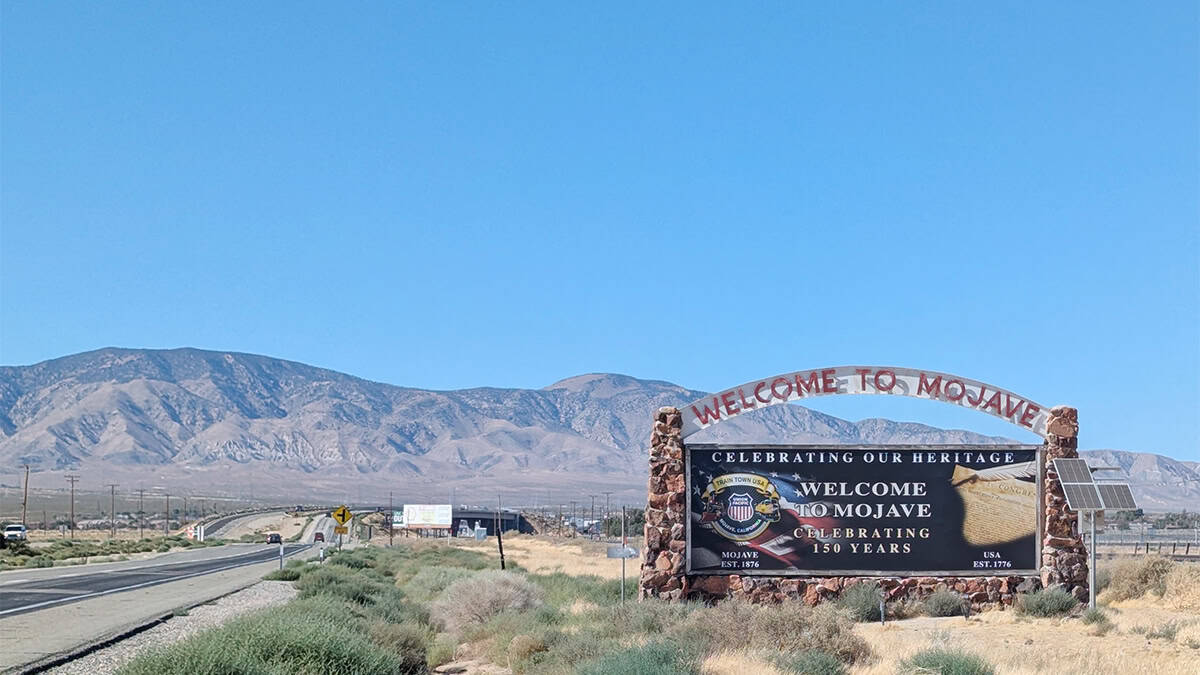
MOJAVE— Gold Rush Days will be celebrated in Mojave this weekend, Oct. 2-4, with the theme “150 years of gold, grit and railroad spirit.”
A drive through this town on the western edge of the desert from which it takes its name provides a glimpse of just those elements as the town celebrates 150 years at the crossroads of history.
Southern Pacific Railroad founded the town on Aug. 8, 1876, after pushing eastward from Bakersfield through the Tehachapi Pass. Engineering of the famed Tehachapi Loop made that possible. The railroad’s arrival in Mojave launched a town, and a month later, SP President Charles Crocker drove a golden spike at Lang Station in Soledad Canyon to the south, completing the connection between the San Joaquin Valley and Los Angeles. That event was commemorated earlier this month.
The railroad still has an important presence in Mojave. The town has survived railroad ownership changes and expansions, with tracks running in every direction and creating important connections and opportunity for industrial operations that provide the East Kern region with jobs.
People have lived in the Mojave region thousands of years, and the railroad routes follow trade routes established by those early residents. Early European and American explorers, including Father Francisco Garces in 1776 and John Charles Fremont in 1844, came this way, traveling through Oak Creek Pass, the winding route that connects Mojave to the Tehachapi Mountains.
Just north of the town, a modern freeway, Highway 58, runs east and west, generally following the route of the railroad, while Highway 14 skirts the western edge of the desert, busy with travelers from Los Angeles and the Eastern Sierra.
Visible from every direction is Soledad Mountain, just south of the town. The volcanic dome once peaked at more than 4,190 feet. Although mining activity has reduced its height, it’s still an impressive landmark. Gold mining began on the mountain in 1894; from 1935 to 1942, the Golden Queen Mining Company’s gold and silver operation there was the largest producer in the desert of southern California.
A war-time order shut down gold production across the country in 1942, but even the war had a silver lining for Mojave.
Military expansion followed the Japanese attack on Pearl Harbor in December 1941, with massive installations established throughout the Mojave Desert. According to the National Park Service, much of that expansion was in the southern part of the Mojave Desert, in San Bernardino County. The desert was considered a wasteland by many, but railroad access and wide-open spaces made it perfect for military training.
In Mojave, an airfield with dirt runways that was built by Kern County in 1935 to serve the local mining industry was taken over by the U.S. Marine Corps in July 1942. As noted on a marker at Mojave Air and Space Port, the property was turned back to the county in 1959. Thousands of troops spent time in Mojave during WWII and the Korean conflict.
Cement production began just east of Mojave in the mid-1950s, when California Portland Cement Company, now CalPortland, established its third cement plant. The company continues to operate there.
A little more than a decade after the military moved out, local voters established the East Kern Airport District, now known as Mojave Air and Space Port at Rutan Field. From the boneyard on the north side of the property, where 100 or more aircraft are stored awaiting maintenance or scrapping, to the massive runway used for testing and horizontal launches, the facility is home to more than 60 companies that continue to make history.
Beginning around 2010, massive wind farms and transmission systems were built in the hills on the western edge of the desert near Mojave, and utility-scale solar farms followed. Installations near Mojave help Kern County produce about 60% of California’s renewable energy.
Gold production on Soledad Mountain resumed in early 2016 and continues.
Industrial development continues as Mojave passes the 150-year mark, with Pacific Steel Group’s Mojave Micro Mill steel recycling and manufacturing facility under construction just south of town, and Hydrostor’s Willow Rock Energy Storage Center staging construction a little further south, between Mojave and Rosamond.
More history
The East Kern Historical Museum Society’s timeline has more details about the history of Mojave from 1876 to 1992.
The Mojave Chamber of Commerce’s Train Town USA page also has history of the railroad in Mojave and a Mojave History timeline.
Mojave Air and Space Port at Rutan Field also provides history from establishment of Mojave Airport in 1935 forward.
Claudia Elliott is founder and editor of The Mojave Beat She can be reached by email: claudia@mojavebeat.news.